Advancing active mobility in greater Prince William, Virginia

Category: Bike Trails (Page 1 of 6)

Our May 2026 Statement to the Commonwealth Transportation Board (CTB)

On May 19, 2026, Active Prince William Co-Chair Allen Muchnick delivered the following statement at the Commonwealth Transportation Board’s (CTB’s) Spring Pre-Allocation Hearing for Northern Virginia (NoVA).

He noted that at the recent rates at which planned active transportation facilities are implemented in NoVA (e.g., 22.4 miles were added in 2025), it will take hundreds of years to establish NoVA’s 5,000 miles of already planned but unfunded active transportation facilities, and he expressed support for the several local active mobility projects that the CTB is presently considering for funding under VDOT’s Transportation Alternatives and Revenue Sharing programs.

To cost-effectively retrofit more active transportation facilities, he asked that VDOT better enable roadway reconfiguration opportunities during scheduled pavement resurfacing throughout urbanized Virginia as well as expand VDOT’s limited program of roadway-reconfiguration  technical assistance.

He further noted that most of US Bicycle Route 1 within Prince William County is hostile for bicycling and in dire need of bike-lane or paved-shoulder retrofits.

Finally, he urged VDOT to establish policies, procedures, and budgets to adequately and proactively maintain its existing active mobility assets, especially VDOT’s extensive sidepaths and sidewalks throughout NoVA.


Commonwealth Transportation Board Pre-Allocation Public Hearing for the Northern Virginia District, May 19, 2026

Statement of Allen Muchnick, Board Member

Virginia Bicycling Federation and Active Prince William 

Good evening.  I’m Allen Muchnick, a Manassas resident and active mobility advocate on the boards of the Virginia Bicycling Federation and Active Prince William.

We appreciate the recent release of VDOT’s Statewide Multiuse Trails Plan and that VDOT is now updating its outdated Statewide Bicycle and Pedestrian Policy Plans.

VDOT has identified 5,000 miles of locally planned but currently unfunded active transportation facilities throughout the NoVA District with an estimated year-2022 construction cost of roughly 14 billion dollars if implemented as standalone projects.  In that regard, we support the transportation alternatives and revenue sharing projects requested by Manassas, Manassas Park, and Prince William County.

At the present rate at which active mobility facilities are created, it would take hundreds of years to complete those already planned active mobility facilities.  Meanwhile, VDOT lacks effective programs to proactively maintain its hundreds of miles of VDOT sidepaths and sidewalks in NoVA.  Our urbanized region needs better programs to more effectively expand and maintain active mobility infrastructure.

Reconfiguring excess travel-lane space on existing roads during scheduled resurfacing is the most cost-effective way to retrofit bike lanes and pedestrian safety improvements.  Since 2010, Fairfax County has effectively used VDOT’s roadway reconfiguration program to improve scores of roadways and reduce speeding during scheduled resurfacing.  Unfortunately, Prince William and Loudoun Counties have been largely excluded from this program because their local transportation planners were not notified early enough of the candidate road resurfacing projects.  VDOT’s maintenance division should extend this earlier notification of repaving candidates to all Virginia counties.  Expanded VDOT technical assistance for roadway reconfiguration projects is also very much needed.

US Bicycle Route 1 through Prince William County is a prime case where retrofitted bike lanes or paved shoulders are desperately needed.  Although AASHTO and VDOT established this Maine-to-Florida bicycle touring route 44 years ago and a VDOT consultant re-evaluated the route’s alignment through NoVA more than a decade ago, most Prince William route segments are hostile for bicycling, as the County’s online Bicycle Skill Level Map and VDOT’s 2015 Bicycle Level of Service Map for the NoVA District both indicate.  We urge VDOT and the County to expeditiously fix those embarrassing and dangerous deficiencies.

Despite hundreds of miles of VDOT-owned shared-use paths and sidewalks throughout the NoVA District, VDOT still performs little maintenance and repair of such assets, except in response to reported complaints.  After construction, the pavement is left to deteriorate for decades and is fixed only after repeated complaints.  VDOT still has no annual budget or established policies and procedures to adequately and proactively assess and maintain its active mobility assets.  The Virginia Transportation Research Council might be asked to study how to best accomplish this perpetual maintenance.

Thank you for this opportunity to comment.

###

 

Our Statement at the CTB’s 2025 NoVA District Pre-Allocation Hearing

On May 8, 2025, Active Prince William’s co-chair, Allen Muchnick, delivered the following statement at the Commonwealth Transportation Board’s spring 2025 Six-Year Improvement Program public hearing for VDOT’s Northern Virginia District:


Commonwealth Transportation Board’s Pre-Allocation Public Hearing for the Northern Virginia District, May 8, 2025, Statement of Allen Muchnick, Co-Chair, Active Prince William

Good evening.  I’m Allen Muchnick, co-chair of Active Prince William.  We advocate for improved active mobility and public transportation throughout greater Prince William, for healthy, livable, equitable, and sustainable communities.

Last December, VDOT’s NoVA District office released an analysis of the roughly 5,000 miles of locally planned but currently unfunded active transportation facilities throughout the District.  That non-exhaustive analysis estimated the present-dollar (2022) cost to create those already planned active mobility facilities to total roughly 14 billion dollars.

At the present rate at which standalone active mobility projects are funded, it would take hundreds of years to complete those already planned active mobility facilities.  The NoVA region needs a study to figure out how to more effectively fund active mobility infrastructure.

Since 2010, VDOT’s roadway reconfiguration program has wisely reallocated excess travel lane space in Fairfax County, to cost-effectively retrofit bike lanes and pedestrian safety improvements on many dozens of roadways during scheduled resurfacing, while also reducing speeding.  However, Prince William and Loudoun Counties have largely been excluded from this program, because their local transportation planners were not notified early enough of the candidate road resurfacing projects.  We urge VDOT’s maintenance division to extend this earlier notification of repaving candidates to all Virginia counties.

The alignment of US Bicycle Route 1 through Prince William County is a prime example where retrofitted bike lanes or paved shoulders are desperately needed.  Although AASHTO and VDOT established this route more than 40 years ago and a VDOT consultant re-evaluated the route’s alignment through NoVA more than a decade ago, the bicycling conditions on several Prince William route segments just get worse.  The County’s online Bicycle Skill Level Map labels Old Bridge Road, part of Minnieville Rd, Aden Rd, and Fleetwood Dr—all lacking bicycle facilities and posted at 45-MPH–as “Roads to Avoid” and tags Hoadly Rd and Tanyard Hill Rd as “Low Comfort”.  VDOT’s 2015 Bicycle Level of Service Map for the NoVA District rated those segments similarly.  It’s long past time for VDOT and the County to fix those embarrassing and potentially deadly deficiencies.

Despite the hundreds of miles of VDOT-owned shared-use paths and sidewalks throughout the NoVA District, VDOT still performs little maintenance and repair of such assets, except in response to reported complaints.  After construction, the pavement is left to deteriorate for decades and is fixed only after repeated complaints.  VDOT still has no annual budget or established policies and procedures to adequately and proactively assess and maintain its active mobility assets.  As a first step, the Virginia Transportation Research Council might be asked to study how to best accomplish this perpetual maintenance.

Thank you for this opportunity to comment.

###
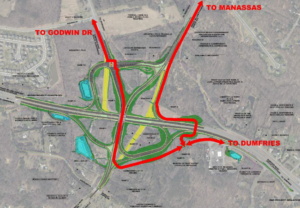
The Rte 234/Brentsville Rd Interchange Needs Better Bike & Ped Access to and from Bus. Rte 234/Dumfries Rd

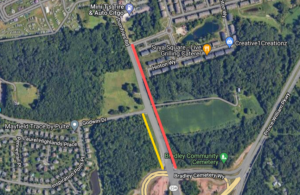
Routing for bicyclists and pedestrians in the approved Route 234/Brentsville Road Interchange Project design

In early February 2024, Active Prince William asked the Prince William County Department of Transportation to improve pedestrian and bicycle access and safety between the Business Route 234/Dumfries Road corridor in the vicinity of Godwin Drive and the Route 234/Brentsville Road Interchange project, which is nearing the end of its construction.  County staff replied that they will look into our request but did not commit to any action.  Our written request is copied below.


Potomac Local’s recent update on the Route 234/Brentsville Road Interchange project reported that this $55 million project is currently $2 million under budget.

We are inquiring about the County’s plans for safe and convenient pedestrian and bicycle access along the Business Route 234/Dumfries Road corridor between the new interchange and the City of Manassas.  From previous correspondence, Mr. Belita indicated a ten-foot wide shared use path will be built along the west side of Business Route 234/Dumfries Road between the Bradley Cemetery Way area and Godwin Drive.

We firmly believe that 10-foot wide shared use paths are needed along both sides of Business Route 234 to provide reasonable and much-needed pedestrian and bicycle access to and from this Interchange.

Along the west side of Business Route 234, the shared-use path between at least Godwin Drive and the Bradley Cemetery Way area will provide safe foot and bicycle access to and from Godwin Drive heading west (including to the adjacent Mayfield Trace community) and could also connect to a future northwestern extension of the regionally significant shared-use path along the Prince William Parkway leading from the Brentsville Road Interchange.  In addition, the nearest shared-use path within the City of Manassas is along the west side of Business Route 234, between Hastings Drive and Donner Drive.

Along the east side of Business Route 234, a shared-use path from the Bradley Cemetery Way area would provide optimal access to the shared-use paths being built within this Interchange project that a) head south to cross over Route 234 to reach both Brentsville Rd heading south and the existing regional path along southbound Route 234 and that b) meander east through the Interchange to reach Liberia Avenue Extended/Route 294 toward Manassas.

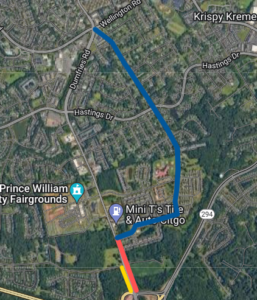
A shared-use path along the east side of Business Route 234 would optimally connect to the existing Bradley Square townhome development and the proposed Bradley South (REZ2003-00027) development.  From Bradley Manor Place, the existing Bradley Square subdivision streets readily lead to South Grant Avenue in the City of Manassas, a pleasant, existing low-traffic route for bicycling and walking that connects to Wellington Road (and from there to downtown Manassas via multiple routes).

We are disappointed that the current Bradley South rezoning proposal is rather inhospitable for bicycling and walking.  Business Route 234/Dumfries Road would have a 50 MPH design speed and a 45 MPH posted speed limit, and the developer of Bradley South would only be required to proffer a sidewalk along the east side of Dumfries Rd.  By contrast, the connecting segment of Dumfries Road at the south end of the City of Manassas has only a 35 MPH posted speed limit (which is better but also too high in our opinion).

Furthermore, with continued residential, commercial, and mixed-use development along the Business Route 234/Dumfries Road corridor (including the Prince William County Fairgrounds), just south of the Manassas City Limits, the density of development will be comparable to that planned along Centreville Road (Route 28) in Yorkshire.

We ask that the budget surplus from this project and proffers from the Bradley South rezoning be used to provide a 10-foot wide shared-use path along the east side of that roadway (Dumfries Rd), from the Bradley Cemetery Way area to at least Bradley Manor Place.

Beyond that, to the extent feasible, the Interchange Project budget should also provide much-needed pedestrian infrastructure for crossing Business Route 234/Dumfries Road at Godwin Drive, including high-visibility crosswalks, at least one raised pedestrian crossing refuge within the roadway median, and either a pedestrian-activated crossing beacon (e.g., HAWK signal) or a conventional traffic signal with full pedestrian crossing components for at least two of the existing intersection legs.

Please let us know how the Route 234/Brentsville Road Interchange Project will suitably accommodate active mobility to and from the already well populated Business Route 234/Dumfries Road corridor.

Without safe and convenient foot and bike connections to the new Interchange from Business Route 234, the new Interchange will degrade active mobility to and from that populated corridor, and the new active transportation infrastructure within the interchange will be very underutilized.  Waiting five or more years for possible future rezonings along Business Route 234/Dumfries Road is not acceptable to complete these critical sections.

If the surplus funds from the Interchange project cannot be tapped to build either another shared-use path or a signalized pedestrian crossing of Business Route 234/Dumfries Road at Godwin Drive, we believe that low-cost or no-cost alternative interim improvements could readily be implemented along the east side of Business Route 234/Dumfries Road that would still substantially improve pedestrian and bicycle access and safety between the Bradley Cemetery Way area and Bradley Manor Place.

Google Street View shows that–before the Interchange was constructed–the paved width of Business Route 234/Dumfries Road was already about four or five lanes wide (i..e., 48 to 60 feet of asphalt pavement) for most of the distance between Bradley Cemetery Way and Bradley Manor Place.  There appears to be only a short stretch between Godwin Drive and the south end of Bradley Square where the pavement narrows to about 36 feet, but only two lanes are presently needed for vehicular travel along that segment.

Thus, the restriping of that roadway segment (with or without any asphalt resurfacing) should allow for at least a continuous 10-foot or wider northbound paved shoulder area leading up to the long right-turn-only lane approaching Bradley Manor Place.  That shoulder area could be protected from roadway traffic with some sort of hard physical barrier to serve as an interim shared-use path along the east side of Business Route 234/Dumfries Road between the Bradley Cemetery Way area and Bradley Manor Place.

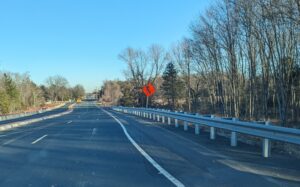
This recent photo (below) of northbound Route 234 Business/Dumfries Road near Bradley Cemetery Way shows that a wide paved shoulder is already present at that location.  While less wide than optimal, that existing paved shoulder could serve as an interim two-way shared-use path if it’s protected from the roadway traffic with a suitable hard barrier.

Northbound Business Route 234/Dumfries Road just north of the Interchange on February5, 2024

In addition, a striped conventional bike lane in each direction may also be feasible.  In the southbound direction, a striped on-road bike lane would be especially useful, from the Manassas City Line to Godwin Drive, for the dozens of bicyclists who participate in Bull Run Bicycles Tuesday Evening Shop Ride, almost every Tuesday evening during daylight saving time.  South of Godwin Drive, a southbound bike lane should not be needed because a new shared-use path will be located along that segment.

Finally, we again request that whatever pedestrian and bicycling improvements cannot be accomplished under the current Interchange project become required proffers as part of the Bradley South rezoning.

Our Comments for the National Capital Trail Network Update in Greater Prince William

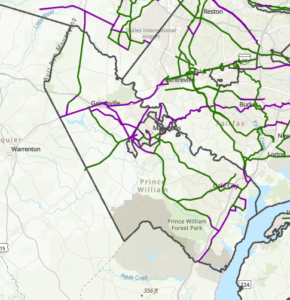
October 2023 draft update of the National Capital Trail Network in greater Prince William.  The green lines are supposed to depict existing trail segments, whereas the purple lines are supposed to depict “planned” trail segments.

The National Capital Trail Network (NCTN) is a 1,400-mile, continuous network of long-distance, off-street trails, serving the entire [metropolitan Washington] region and consisting of both existing and planned segments.  The network was approved by the National Capital Region Transportation Planning Board (TPB) in July 2020 and endorsed by the Metropolitan Washington Council of Governments Board of Directors in August 2020.

As described by TPB staff:  The National Capital Trail Network is intended to be a network of long-distance, off-street facilities. It will be accessible for people of all ages and abilities, designed for non-motorized use, and suitable for both transportation and recreation.  Off-street path width minimums are 10 feet for new construction, 8 feet for existing paths. Paths must be paved or firm surface. On-street facilities must be protected from moving traffic (i.e. parked cars, curbs, or flexposts). All facilities must be directly connected to the network. Short on-street connections on low-volume, low speed streets are permitted to maintain network continuity. Facilities can be existing or planned, but they must be in an approved agency plan.

In June 2022, the TPB adopted a resolution (R18-2022) that called for completing the TPB’s National Capital Trail Network by 2030, as one of seven priority strategies for reducing greenhouse gas emissions from surface transportation in the Washington region.

For at least several months, the TPB staff have sought to engage the region’s localities to submit updates and corrections to the NCTN mapThe main purpose of this update is to measure progress, in miles built, toward the completion of the National Capital Trail Network since its adoption in 2020. Other purposes include adjusting routes where the existing route has proven infeasible or undesirable, addition of new routes where a new plan or new development justifies it, and correction of errors or omissions in the network [emphasis added].

To facilitate this update, Active Prince William submitted the comments below on October 30, 2023.


Comments on the Draft Update to the National Capital Trail Network Map for Prince William County and the City of Manassas
by Allen Muchnick, Co-Chair Active Prince William

1) Nonexistent/”Planned” Trail Segments Erroneously Labeled As “Existing”:  The following segments on the NCTN map should be relabeled as “planned” because they do not currently exist.

  • Nokesville Rd/Rte 28 between the Fauquier County Line and Fitzwater Dr in Nokesville. The segment of Rte 28 west of Fitzwater Dr in Nokesville has not been widened.  It’s still a two-lane road without any bicycle or pedestrian facilities.
  • Minnieville Rd, between Old Bridge Rd and Dumfries Rd, is depicted as having an existing shared use path along it except for the segment (TIP_ID BP11611) between Fowke Ln and Cardinal Drive. However, the NCTN update map erroneously shows this planned segment with a southwest terminus at Smoketown Rd, rather than at Cardinal Dr.  The segment of Minnieville Rd that currently lacks any bicycle facilities is much longer than shown on the NCTN update map.

2) NCTN Segments Currently Labeled As Planned That Have Recently Been Completed:  The following NCTN segments should now be relabeled as “existing”.

  • Nokesville Rd/Rte 28 Shared-Use Path, between Godwin Dr and the PWC Line, in the City of Manassas (TIP_ID 11606).
  • Godwin Dr Shared-Use Path (south), between Wellington Rd and the Winters Branch Trail, in the City of Manassas (TIP_ID BP11604). Note: TIP_ID BP7624 appears to be a duplicate path, possibly on the PWC side of Godwin Dr, which is probably not actually planned and, if so, should be deleted from the map.
  • US-1 Shared-Use Path in North Woodbridge (southern segment of TIP_ID BP7634): The segment between Annapolis Way and Gordon Blvd is complete.
  • Blackburn Rd Shared-Use Path near Neabsco Creek (the bulk of TIP_ID BP7641): The segment between Rippon Blvd and Good Shepherd Lutheran Church is complete.
  • Wellington Rd Shared-Use Path (the western end of TIP_ID 7632): The segment between Linton Hall Rd and University Blvd near Gainesville/Virginia Gateway is complete.
  • VA 234/Dumfries Rd Shared-Use Path (TIP_ID BP7639): This former gap segment between Country Club Dr and Exeter Dr near Montclair is complete.

3) Planned NCTN Segments Depicted On An Erroneous Alignment:

4) Planned NCTN Segments That Should Be Updated: 

  • Manassas Dr east of Signal View Dr in Manassas Park (TIP-ID BP7643): The new Manassas Park Active Transportation Plan identifies an even larger segment of eastern Manassas Dr (between Railroad Dr and Blooms Park) as a candidate for bicycle lanes implemented with a road diet (Project B-10). The NCTN map currently labels the segment of Manassas Dr east of Signal View Dr as planned for a shared-use path.

5) Nationally Significant Long-Distance Trails That Should Be Added to the NCTN Map As “Planned NCTN Segments”:

  • US Bicycle Route 1: At present, a considerable portion of US Bicycle Route 1 through Prince William County is quite hostile to bicycling, even by experienced cyclists.  However, the segments of this route along Fleetwood Dr (Fauquier County Line to Aden Rd), Aden Rd (Fleetwood Dr to Bristow Rd), Bristow Rd (Aden Rd to Independent Hill Dr), Independent Hill Rd (Bristow Rd to Route 234), all of Hoadly Rd, Minnieville Rd (the segment missing a shared-use path from Prince William Pkwy to Fowke Ln), and Old Bridge Rd (Minnieville Rd to Tanyard Hill Rd) are all identified for future shared-use paths in Prince William County’s December 2022 Comprehensive Plan and therefore should be depicted as Planned NCTN segments on the updated NCTN map.
  • East Coast Greenway and Potomac Heritage National Scenic Trail: Except to depict existing or planned sidepaths along Route 1, the current NCTN map does not depict most of the planned ultimate route(s) for the East Coast Greenway and the paved, shared-use segments of the Potomac Heritage National Scenic Trail through Prince William County.  The updated NCTN map should depict those planned routes.

###

Our Comments on the Mayfield Crossing Rezoning Application

Our key recommendations for the proposed Mayfield Crossing development are summarized above

On August 28, 2023, a rezoning application (Plan Number: REZ2024-00007; Mayfield Crossing) was submitted to Prince William County for a proposed new residential development at the intersection of Manassas Drive and Signal View Drive, just outside the City of Manassas Park.   The applicant seeks to rezone a forested 20.56-acre parcel adjacent to Signal Hill Park to develop a residential community with up to 288 dwelling units.  On September 5, Active Prince William submitted the following initial feedback on the proposed development:


We have reviewed the Mayfield Crossing Rezoning package [8/28/2023] (corner of Manassas Dr. and Signal View Dr.) posted through the PWC DAPS.  While we are disappointed to see this wooded lot adjacent to the Signal Hill Park be developed, we hope you consider the following comments and feedback as this project moves through the rezoning process.

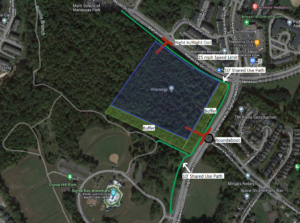
Our concerns are regarding 1) bike/pedestrian infrastructure along Manassas Dr and Signal View Dr (connection to Signal Hill Park), 2) ingress/egress from the new development, and 3) the viewshed from Signal Hill Park/Signal View Dr.  Above is a diagram of our recommendations which are explained in detail below:

1. Bike/pedestrian infrastructure along Manassas Dr and Signal View Dr (connection to Signal Hill Park)

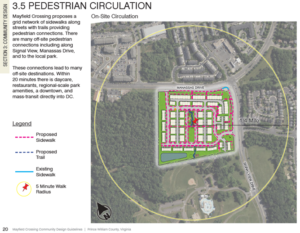
Below is a diagram of the current language for Pedestrian Circulation in the rezoning package.  The draft Manassas Park Active Transportation Plan calls for a shared-use path along Manassas Dr and a sidewalk along Signal View Dr next to the development.

The applicant’s proposed Pedestrian Circulation Plan

We recommend the applicant construct:

  • A shared-use path along Manassas Dr, from Digital Dr to Signal View Dr.
  • A shared-use path along Signal View Dr, from Manassas Dr to the Signal Hill Park Entrance.

Justification: These recommendations complete the trail segments adjacent to the development and the necessary connections to provide a safe connected bike/ped network to nearby destinations.  A shared-use path along Signal View Dr is more aesthetically pleasing and matches the existing infrastructure along the roadway.  In addition, it reduces the need to cross Signal View Drive in front of Signal Hill Park, which can be a hazard for people walking and bicycling.

2. Ingress/egress from the new development

The current language for ingress/egress in the rezoning package is below:

The site layout has approximately 950 feet of frontage along Manassas Drive to the north and 800 feet of frontage along Signal Hill Drive. Access to the site is proposed at a full movement entrance along Manassas Drive opposite Christopher Lane and a full movement entrance along Signal View Drive opposite Roseberry Farm Drive.

The package also indicates right-turn deceleration lanes on Manassas Dr and Signal View Dr. to access the new development

We recommend the applicant construct:

  • Right-In/Right-Out access to/egress from the new development on Manassas Dr with no deceleration lane.  We also recommended that the City of Manassas Park lower the speed limit on Manassas Dr, from Signal View Dr to Railroad Dr, to 25mph.
  • A Single-Lane Roundabout on Signal View Dr at the intersection of Roseberry Farm Dr and the ingress/egress point of the new development.

Justification:  As this area continues to urbanize, we must design our transportation network for all users and not on the elements that enable the fast movement of motorized vehicles.  A 25-mph speed limit would eliminate the need for a deceleration lane on Manassas Dr, whereas the full-movement unsignalized intersection on Manassas Dr proposed by the applicant would create more conflict points that lead to an increase in vehicle crashes.

A roundabout on Signal View Dr would provide much safer ingress/egress for residents of Roseberry Farms as well as residents of the new development.  It would also reduce the speed of vehicles on Signal View Dr and enable an opportunity to create gateway signage to enter Signal Hill Park (Signal Hill Park is on both sides of Signal View Dr.)

3. Viewshed from Signal Hill Park/Signal View Dr

The current illustrations in the rezoning package show limited or no tree buffer along Signal View Dr and along the south side of the development adjacent to Signal Hill Park.

We recommend that the applicant:

  • Maintain a 50’-100’ tree buffer along Signal View Dr (similar to Roseberry Farms)
  • Maintain a 50’-100’ tree buffer along the south side of the development adjacent to Signal Hill Park
  • Bury all utilities along Manassas Dr, from Digital Dr to Signal View Dr
  • Bury all utilities along Signal View Dr adjacent to development (prefer if all utilities could be buried in Signal Hill Park)

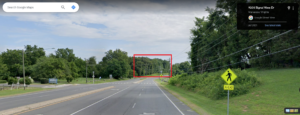
Justification:  The viewshed from the Civil War Monument/Entrance to Signal Hill Park along Signal View Dr should be maintained.  See picture below.

The current view from Signal View Drive (from Google Maps Street View)

Thank you for considering these recommendations as the Mayfield Crossing Rezoning project moves through the rezoning process.

###

« Older posts