Advancing active mobility in greater Prince William, Virginia

Tag: Clover Hill Road

Our Comments on the Proposed Prince William Parkway and Clover Hill Road Diverging Diamond Interchange

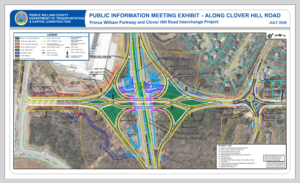
Proposed diverging diamond interchange at Prince William Parkway and roundabout at Godwin Drive

Proposed diverging diamond interchange at Prince William Parkway and roundabout at Godwin Drive

On July 30, 2026, Prince William County’s Department of Transportation and Capital Construction held a public information meeting to present and discuss its preliminary proposal to construct a diverging diamond interchange (DDI) at Prince William Parkway and Clover Hill Road, to reduce travel delays along the Parkway and accommodate the planned introduction of scheduled commercial airline service at the newly renamed Washington Manassas Airport.

On August 12, 2026,  Active Prince William Co-Chair Allen Muchnick submitted the following public comments to supplement the comments submitted previously by Co-Chair Mark Scheufler and by member Connor Young, both of whom are professional engineers.   Connor’s detailed comments in the form of a PowerPoint presentation can be viewed here.


Re: Proposed Design for the Prince William Parkway and Clover Hill Road Interchange Project

I’m writing on behalf of Active Prince William to comment on the proposed design for the Prince William Parkway and Clover Hill Road Interchange Project as presented at the July 30, 2026 public information meeting.   This letter supports and expands upon the comments previously submitted by Active Prince William members Mark Scheufler and Connor Young.

1. Examine More Cost-Effective Alternatives to a Diverging Diamond Interchange:

A diverging diamond interchange seems excessive for the anticipated future traffic volumes at this location, and we recommend that the project team evaluate an interchange design similar to that recently approved for the Prince William Parkway/Sudley Manor Drive Interchange which would serve both Sudley Manor Drive and Wellington Road traffic.

For 2025, the annual average daily traffic (AADT) volumes along these adjoining segments of Clover Hill Road (Rte 3235) was only 3200, far less than the traffic volumes on the two existing Prince William County highways with diverging diamond interchanges, both of which are high-speed, high-volume, median-divided arterial roadways.  Route 15 at I-66 had a 2025 AADT of 38,000, whereas Balls Ford Road (Rte 621) at Prince William Parkway had an AADT of 20,000.  Thus, Clover Hill Road would still carry far less traffic than either existing diverging diamond interchange did in 2025, even if Clover Hill Road traffic volumes were to double or triple with the future expansion of Washington Manassas Airport.

For the proposed Prince William Parkway/Sudley Manor Drive interchange, the existing at-grade intersections along Prince William Parkway at both Sudley Manor Drive and Wellington Road would be modified to allow only right-in and right-out traffic movements, and both Sudley Manor Drive and Wellington Road would cross over the Prince William Parkway on a single new roadway overpass on a new alignment.

In 2025, Sudley Manor Drive had an AADT of 26,000 on the east side of Prince William Parkway, while the adjoining segment of Wellington Road had an AADT of 18,000.  If such an interchange design can handle two arterial roads with a combined AADT of 44,000, a similar interchange design should have ample capacity to accommodate Clover Hill Road well into the distant future.
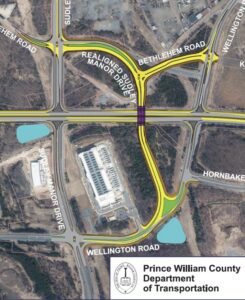
 

The approved design for the Prince William Parkway Interchange at Sudley Manor Drive and Wellington Road

Thus, the design team should explore a Clover Hill Road-Prince William Parkway interchange design where Clover Hill Road’s existing at-grade intersections with the Parkway are modified to allow only right-in and right-out traffic movements, and a new Clover Hill Road overpass of the Parkway would be constructed on a different alignment.

Even if Clover Hill Road traffic volumes were to grow five- or six-fold in the future, this new Clover Hill Road bridge should function effectively with only one travel lane in each direction (and only a single shared-use path and no sidewalk along one side of the bridge should be adequate).  The project savings due to the narrower and simpler bridge could be enormous.  The bridge roadway could connect to the existing segments of Clover Hill Road with either roundabouts or signalized intersections.
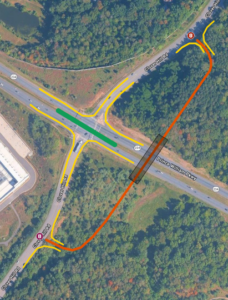
Our alternative, lower-cost proposal for the Prince William Parkway and Clover Hill Road Interchange

It does not appear that such an interchange concept has been evaluated for this project.  If indeed feasible, this alternative concept should cost considerably less to build and be much easier to fully fund.

2.  Extend the Project Limits Northwest Along Godwin Drive in the City of Manassas to Reach Winged Elm Circle

Godwin Drive in the City of Manassas–between Clover Hill Road and the southeast leg of Winged Elm Circle–has only one narrow sidewalk, no shared-use paths, and no bicycle lanes.  To provide continuous on-road bike lanes between the proposed roundabout and the southeast leg of Winged Elm Circle, the project limits should be extended northwest about 850 feet along Godwin Drive to Winged Elm Circle.  Ideally, a second sidewalk or a shared-use path should also be constructed along this segment of Godwin Drive along its northbound side.
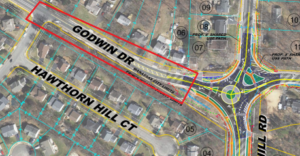
Godwin Drive between the proposed roundabout at Clover Hill Road and the southeast leg of Winged Elm Circle

Building this missing bike lane segment would finally provide a continuous bicycle facility along Godwin Drive between Hastings Drive and Clover Hill Road.  As traffic volumes increase along Godwin Drive due to the future expansion of Washington Manassas Airport, the need for a continuous bicycle facility will grow considerably.

3.  Install Shared-Lane Markings to Guide Bicycling Movements though the Clover Hill Road-Godwin Drive Roundabout.

Although the proposed design includes shared-use paths along the rebuilt segments of Clover Hill Road and along the roundabout, most people bicycling through the roundabout will be approaching and leaving the roundabout on the roadway and won’t necessarily access any shared-use path unless they are traveling to the airport along the rebuilt segment of Clover Hill Road.
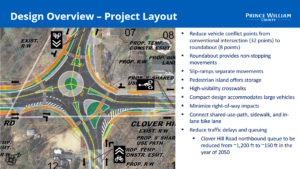
Proposed roundabout at Clover Hill Road and Godwin Drive

Installing shared-lane bicycle markings (sharrows) within the roundabout would especially help guide bicycling movements between both legs of Godwin Drive and the leg of Clover Hill Road approaching the City of Manassas and also assist in calming traffic.

4.  Design the Interchange to Effectively Accommodate the Planned Future Shared-Use Path along Prince William Parkway.

We appreciate that the design of this project would incorporate the right-of-way for a future shared-use path along the northbound side of the Prince William Parkway.  Please ensure that the design of this project would a) accommodate that shared-use path without any motor-vehicle cross-flows and b) connect seamlessly to the new shared-use paths along Clover Hill Road that will be built as part of this Interchange project.

One way to accomplish this would be to incorporate box culverts in this project beneath all new parkway exit and entrance ramps on the northbound side of the Parkway, to provide a safe and efficient underpass route for the future shared-use path along the Parkway.  Doing so would also reduce the cost and disruption needed when the long-planned shared-use path along this segment of the Parkway is finally built.

5.  Appropriately Design Clover Hill Road on the East Side of the Parkway and the Roundabout at Godwin Drive for Slow Vehicular Speeds through Residential Neighborhoods.

While the proposed lane widths and vehicular capacity for Clover Hill Road and the DDI Bridge seem excessive and would unnecessarily inflate project costs and degrade highway safety, it is especially important that Clover Hill Road on the east side of the Parkway and the Godwin Drive Roundabout be designed for slow (under 25 MPH) travel speeds appropriate for residential neighborhoods.  In that regard, the travel lanes and circulatory lanes in the roundabout should be 10 feet (or at most 11 feet) wide, especially since a wide truck apron in the roundabout would adequately accommodate all oversized vehicles and since the roundabout would include a dedicated right-turn-only lane for traffic heading southeast on Godwin Drive.

In addition, residential traffic-calming measures, such as speed humps along northbound Clover Hill Road and speed tables at the crosswalks within the roundabout should be considered.


Thank you for giving the public this opportunity to comment at an early stage of project design.  We very much appreciate the commitment of the project team to integrate pedestrian and bicycling infrastructure and safe roadway crossings into the design of this project.
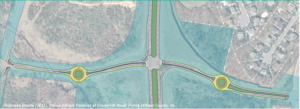


Our Input for the Route 234-Clover Hill Road Bowtie Intersection

2017 Concept for a Clover Hill Road/Prince William Parkway “Bowtie” Intersection

Recently, the Prince William County Department of Transportation asked for our feedback on their proposed preliminary design for rebuilding the intersection of the Prince William Parkway (Route 234) and Clover Hill Road near Manassas as an “innovative” bowtie intersection, where all direct left turns are eliminated and instead accommodated via two roundabouts on the minor cross street.   Our reply is posted below.   We will track this upcoming project in the coming years as the design is refined for construction.


Thank you for soliciting Active Prince William’s input on how the redesigned intersection of Clover Hill Road at the Prince William Parkway can best serve people walking and bicycling.

Conventional On-Road Bike Lanes Are Appropriate for Clover Hill Road

Clover Hill Road provides an important low-traffic bicycling connection between the City of Manassas (and adjacent residential neighborhoods within the County) and Manassas Regional Airport and points west, including the Broad Run VRE station and the new Route 28 shared-use path that now extends though Bristow all the way to Nokesville.  On the southwest side of Route 234, Clover Hill Road provides critical bicycling access to a network of low-traffic, bicycling-friendly roads within and near Manassas Regional Airport, including Harry J Parrish Blvd. Wakeman Drive, Observation Drive, Piper Lane, Residency Road, Pennsylvania Avenue, Carolina Drive, and Gateway Blvd.

As such, Clover Hill Road is eminently useful for bicycle commuting to employment sites within and near the airport, to the Broad Run VRE station, and to points west in Bristow.  In addition, Clover Hill Road and the low-traffic roads within and around the airport are used extensively for recreational bicycling on evenings and weekends.

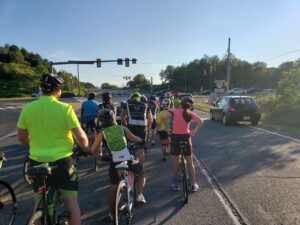
Bicyclists on Bull Run Bicycle’s Tuesday evening shop ride wait to cross Route 234 at Clover Hill Road. To avoid hazardous right-turning traffic on both sides of this intersection, the group waits for a green traffic signal in the left travel lane of Clover Hill Road.

Both City of Manassas roadways that connect to this segment of Clover Hill Road–i.e.. Clover Hill Road from Godwin Drive to Wellington Road and Godwin Drive from Clover Hill Road to Hastings Drive–already have conventional on-road bike lanes.  Thus, in addition to including sidewalks for pedestrians, the entire redesigned segment of Clover Hill Road should include conventional on-road bike lanes in both directions.

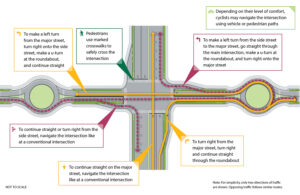
Note that VDOT’s website that describes bowtie intersections includes conventional on-road bike lanes on all four legs of that intersection (see the illustration copied below).

Since, as in the above illustration, the proposed design features dedicated right-turn-only lanes on Clover Hill Road at both approaches to the Prince William Parkway, it would be vital to install the bike lanes at both approaches to the Prince William Parkway between the straight-through travel lane on the left and the right-turn-only lane at the curb.

Within the roundabouts, the bike lanes–if any–should be on the far right and could be buffered or physically separated from roadway traffic.  Alternatively, especially if right-of-way is constrained at the roundabouts, the bike lanes could be discontinued within the roundabouts and bicyclists encouraged to navigate the roundabouts as either a driver centered within the travel lane or (using strategically placed curb ramps for access and egress) as a pedestrian using the sidewalk.

However, upon exiting each roundabout, right-turning motorists should be directed to yield to any bicycle traffic ahead and to carefully merge right across the continued bike lane to enter the emerging right-turn-only lane before reaching either the Parkway (along both southbound and northbound Clover Hill Road) or Godwin Drive (along northbound Clover Hill Road).

Please note that these same conflicts between right-turning motorists and straight-through bicyclists presently exist at the current Clover Hill Road/Route 234 Intersection in the absence of any bike lanes and that appropriate traffic engineering measures, involving pavement markings and signage, can optimize the safety of all road users.

Design This Intersection to Safely Accommodate the Future Shared-Use Path Along Route 234

Although this project won’t construct the long-planned missing shared-use path along Route 234, the design of this intersection should not preclude its future construction and should also ensure that pedestrians and bicyclists using that shared-use path can cross Clover Hill Road safely.  As a designated segment of the National Capital Trail Network, a continuous, high-quality shared-use path along Route 234 should be a priority for Prince William County.

Unobstructed right-of-way should be acquired and preserved as part of this project to accommodate the future Route 234 shared-use path, and the project design should ensure that the route and future design of this path would not be blocked or compromised by noise barriers, above-ground or buried utilities, or roadside signage, traffic signals, or street lighting.  Until the county decides whether this path will be constructed on the northeast or southwest side of Route 234, right-of-way should be reserved for the future shared-use path on both sides.

In addition, the intersection design should ensure that the future Route 234 Trail will have a safe, at-grade crossing of Clover Hill Road, presumably coordinated with the same traffic signal that regulates the Route 234 traffic.

Eliminate High-Speed Right-on-Red Turning Movements from Route 234 onto Clover Hill Road

Unlike VDOT’s model bowtie intersection illustrated above, the currently proposed intersection design incorporates two free-flowing, high-speed, right-turning movements, using pork-chop islands, for Route 234 traffic to enter Clover Hill Road.  We believe this currently proposed design feature would seriously endanger both 1) bicyclists and pedestrians crossing Route 234 at Clover Hill Road and 2) the users of the future Route 234 Trail crossing Clover Hill Road.

Vulnerable, non-motorized road and trail users who are crossing either roadway on a green traffic signal should not be endangered by high-speed traffic that is simultaneously turning right-on-red at near-freeway speeds at these pork-chop islands.  While a decision to completely ban all right-turn-on-red movements at this intersection might best be made by expert traffic engineers, we firmly believe that free-flowing right-on-red movements would be dangerous at this intersection and should not be promoted by design features such as pork-chop islands.

Instead, vehicle traffic entering Clover Hill Road from Route 234 should be encouraged to slow to the 25 MPH posted speed and carefully merge into the single travel lane approaching the roundabout, while bicyclists who have just crossed Route 234 on a green signal must merge into the bike lane at the right edge of the roadway.

Again, careful pavement marking and signing would help all road users safely negotiate these conflicts, whereas a design that promotes high-speed right-on-red vehicle traffic would endanger vulnerable road users.

Bicyclists and pedestrians crossing Route 234 at Clover Hill Road on a green traffic signal would primarily be endangered by motorists turning right-on-red from Route 234 at the far side of their crossing.  By contrast, users of the future Route 234 Trail crossing Clover Hill Road on a green traffic signal could encounter both motorists turning right-on-green from Route 234 as well as motorists turning right-on-red from Clover Hill Road.   All such right-turning movements would be safer if the design encourages motorists to slow or stop completely before entering a crosswalk and turning into the path of vulnerable road users.  Partial traffic signal phasing, such as leading pedestrian intervals, could also make these crossings safer.

Clover Hill Road is a local street posted for 25 MPH, and there is no compelling need to promote free-flowing right-turn-on-red vehicle movements onto Clover Hill Road.

The 2019 AADT for all connected local roadways (i.e., Clover Hill Road, Godwin Drive, and Harry J Parrish Blvd) ranges from 2100 to 4700, so Clover Hill Road only needs one travel lane per direction between intersections. The proposed design includes a grassy median along Clover Hill Road, but there’s no compelling need for a grassy median on a road posted for 25 MPH, and that grassy median is about a full-lane wide on the segment approaching Godwin Dr.

Active Prince William also supports the inclusion of a shared-use path along this entire segment of Clover Hill Road; however, such a path would not connect to any existing path along Clover Hill Road, Godwin Drive or Harry J. Parrish Blvd, and it appears that the long-planned path along the Route 234 Bypass won’t be built for the foreseeable future.  Thus, a shared-use path seems less essential, especially on the airport side of Route 234, provided that both sides of Clover Hill Road will have sidewalks and bike lanes.

If spatial or terrain constraints would otherwise preclude the addition of both on-road bike lanes and sidewalks along Clover Hill Road in both directions, consideration should be given to narrowing or eliminating the grassy medians.

Thank you for considering our input.

###