Advancing active mobility in greater Prince William, Virginia

Tag: Active Prince William (Page 2 of 6)

Our Recommendations for PWC’s Traffic Safety Action Plan


On May 5, 2025,  Active Prince William submitted the following recommended programmatic actions for Prince William County’s Comprehensive Traffic Safety Action Plan that is now under development.  We look forward to seeing our recommendations incorporated in the adopted plan and implemented by PWCDOT and VDOT in the years to come.  View our official comment letter.


Active Prince William’s Recommended Programmatic Actions for Prince William County’s Safe Streets and Roads for All Action Plan

1) Reduce the design speed for all commercial arterial roadways (e.g., Richmond Highway, Sudley Road, Centreville Road, Dale Boulevard) to 35 MPH or less.  Speed kills.  If VDOT is willing to reduce the posted speed limit on parts of US-1 to 35 MPH in Fairfax County and to 25 MPH in Arlington County (with the local governing body’s concurrence), it will do the same in Prince William County.

2) Avoid and eliminate right-turn-only lanes on commercial arterial roadways, to shorten the crossing distance for pedestrians, lower vehicle speeds and improve yielding behavior at intersections, and reduce traffic crashes.

3) Eliminate overly wide (e.g., all 12-ft) travel lanes and excess roadway capacity through roadway reconfigurations (e.g., lane diets and road diets).   Wide and unwarranted travel lanes promote speeding and consume valuable public street space that could be reallocated to better accommodate non-vehicular travel modes and/or turning or parked vehicles.

 4) Establish a robust roadway reconfiguration program–in conjunction with scheduled VDOT roadway resurfacing projects–to retrofit bike lanes and pedestrian safety improvements, at little or no cost to Prince William County, through lane diets and road diets.   As Fairfax County DOT has accomplished for well over a decade, roadway reconfigurations during scheduled VDOT resurfacing projects can substantially and cost effectively expand a locality’s bikeway network and improve pedestrian comfort and safety.

5) Improve intersection safety for pedestrians, where warranted, by installing pedestrian crossing signals with Leading Pedestrian Intervals, high-visibility (and raised) crosswalks, and improved street lighting.  Reduce pedestrian crossing distances with lane reductions, bike lanes, pedestrian refuges, and/or curb extensions (aka bulb outs), and slow turning vehicles by reducing curb- return radii.

6) Add signalized pedestrian crossings of commercial arterials where the existing signalized crossings are too widely spaced.

7) Improve sidewalk safety and comfort for pedestrians and reduce mid-block traffic crashes by consolidating commercial driveway entrances and by installing raised medians during road reconstruction and rehabilitation projects.  Meanwhile, all existing driveway aprons on sidewalks should receive high-visibility crosswalk markings until such driveway aprons are eventually removed.

8) Grade separate all trail crossings of multilane roadways, especially as part of interchange construction projects.  Install raised crosswalks at at-grade sidewalk and trail crossings to enhance the visibility and reinforce the right-of-way of crosswalk users and to slow approaching traffic.

9) Ensure that all roadway crossings of streams are planned, designed, and effectively inventoried by VDOT to accommodate existing and future stream valley trails beneath the roadway or within the steam culvert.

10) Avoid and eliminate all at-grade sidewalk and trail crossings of multilane turn lanes or highway ramps, to preclude dual-threat or multi-threat crossing situations, where the drivers in every lane must stop for (or yield to) vulnerable road users and already-stopped vehicles may block the view of crossing pedestrians.

11) Install signs, pavement markings, and flashing beacons, as appropriate, to alert turning drivers to crossing vulnerable road users at free-flow right-turn lanes (aka slip lanes).

12) Ensure that all segments of US Bicycle Route 1 within Prince William County attain an acceptable Bicycle Level of Service (BLOS) of C or better, through roadway reconfigurations, route realignments, paved shoulder retrofits, and/or shared-use path construction or reconstruction, following up on this circa 2013 route evaluation.  The deficient route segments currently include Fleetwood Dr, Aden Rd, Joplin Rd, Bristow Rd, Hoadly Rd, Minnieville Rd, Old Bridge Rd, and Tanyard Hill Rd.

13) Establish Prince William County procedures for snow and ice removal from sidewalks and shared-use paths, especially along bus routes.  VDOT, by established policy, does not remove snow or ice from its sidewalks or shared-use paths, but after the roads have been cleared, sidewalks, paths, and bus stops may be blocked for many days and even weeks by mounds of plowed snow and ice, forcing pedestrians and bus riders to walk in the roadway.  Do Prince William County and its four towns have and enforce snow-removal ordinances?  Could volunteers be enlisted to adopt a road segment for snow clearing?  Are both the County and PWCS equipped and mandated to remove snow and ice on sidewalks and paths that front PWC- or PWCS-owned parcels?

14) Establish and enforce Prince William County procedures to ensure the maintenance of traffic (MOT) for people using sidewalks or shared-use paths during nearby construction projects.

15) Establish programs to identify, inspect, prioritize, and annually fund the construction, repair, replacement, and upgrade of sidewalks and shared-use paths, by the County and by VDOT.

16) Establish a program to identify, prioritize, fund, build, and maintain neighborhood cut-through paths that connect low-traffic subdivision streets.

17) Develop and promote a bicycle comfort level (level of traffic stress) map for Prince William County, building upon a previous effort.

18) Establish a PWC quick-build program to test road reconfiguration concepts in a cost-effective and timely manner.

19) Implement a strategic and data-driven program of automated traffic law enforcement to the fullest extent allowed by the Commonwealth of Virginia.

20) Continuously track and report annually on traffic crashes, injuries, and fatalities to identify their leading causes and locations and to monitor progress.

21) Develop a strategic and comprehensive active transportation master plan for Prince William County, guided by an expert team of outside consultants.

###
Our Comments on PWC’s Proposed Route 1 Widening

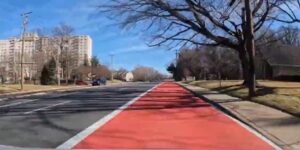
A bus priority lane on University Boulevard in Montgomery County, MD

On January 16, 2025, Active Prince William sent the following comments to the Prince William Board of County Supervisors (BOCS) in response to a new funding request by County staff to initiate the widening of a new segment of U.S. Route 1 (between Cardinal Dr and Dumfries Rd), to create a high-speed arterial roadway with six through travel lanes for personal motor vehicles.

PWC BOCS,

After reviewing Agenda Item 8A on the 1/21/25 PWC BOCS Agenda, we are disappointed there was no public announcement and input opportunity for these priorities/plans before the agenda’s release.

While we  acknowledge that the Route 123/Old Bridge Rd flyover, Sudley Manor Dr/Route 234 Interchange, and Clover Hill Rd/Route 234 Intersection are active projects, we are disappointed that the Route 1 widening project is part of this agenda item.

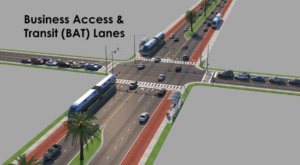
This Route 1 corridor segment, which includes the highest ridership Omniride local route (53 | Dumfries Connector), provides an opportunity to scope a major transit project by adding bus lanes or business access and transit (BAT) lanes.

Route 1 should be designed as a walkable and livable mixed-use regional activity center, not as a mini I-95. The county should reject the long-discredited mindset that widening commercial roadways is a viable long-term strategy that improves resident quality of life.

Such widening projects induce an even-higher vehicle mode share, burden families with increased vehicle ownership costs, render active mobility unsafe and miserable, and generate negative environmental externalities, such as noise, air, and water pollution.  This project would depress transit ridership in favor of increased vehicle speeds, reduced safety, and more traffic congestion for future generations. These outcomes are in direct conflict with many proposed strategic plan goal elements.

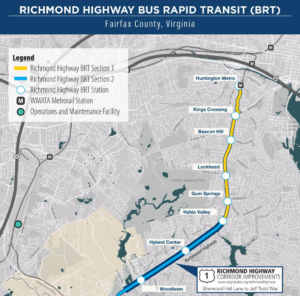
While PWC transportation staff is proposing widening Route 1 this week, Arlington County and VDOT are recommending removing interchanges from their section of Route 1 and lowering the speed limit to 25 MPH, to reconnect the community as part of major economic development initiative, while Fairfax County and VDOT are advancing a major Bus Rapid Transit initiative along Route 1.

Prince William County is no longer a rural/exurban county with 200,000 people like Stafford County; it’s an increasingly urban county of almost 500,000 people that must significantly diversify its transportation mode share to improve quality of life for its residents.

We need to prioritize affordable housing AND affordable transportation.

We recommend the PWC BOCS:

  • Gather resident input on more sustainable alternatives for this Route 1 segment
  • Initiate a Citizen Transportation Advisory Commission, to vet transportation project priorities in a public forum before they reach the BOCS agenda
  • Prioritize projects that reduce Vehicle Miles Traveled

Thank you for considering this feedback.

Mark Scheufler & Allen Muchnick, Co-Chairs
Active Prince William
Advancing active mobility for a more livable, equitable, & sustainable greater Prince William, Virginia
Twitter: @Active_PW https://twitter.com/Active_PW

If At First You Don’t Succeed, Send Another Email


On December 17, 2024, Active Prince William sent the email below to the Prince William Board of County Supervisors to–yet again–protest the Board’s long-standing practice of placing their approval of staff applications for transportation project funding on the BOCS Consent Agenda, in the absence of any prior public involvement process.


Dear Chair Jefferson and County Supervisors:

Active Prince William asks–once again–that the Board of County Supervisors require the Prince William County Department of Transportation to present the Department’s proposed mobility project funding submissions for public input at an advertised public hearing before they are submitted for the Board’s approval on a consent agenda.

Your December 17, 2024 BOCS Consent Agenda includes Item 4-F, listing two mobility projects for grant applications for Congestion Mitigation Air Quality (CMAQ) and Regional Surface Transportation Program (RSTP) funds in FY 2031.  The public was unaware of which specific projects would be identified until the BOCS agenda was posted.

This consent agenda action—in the absence of any prior public input opportunities—perpetuates the same opaque decision process of previous Boards. The decision will be ratified by the BOCS before Public Comment Time and with no public announcements or public input opportunities in advance regarding which projects were considered for funding.  All decisions were made by county staff behind closed doors, and endorsed by the BOCS before Public Comment Time.

The two projects in Item 4-F may well be the best ones to advance at this time–but maybe not.  Moreover, the public was never given any opportunity to ensure that the proposed scope and budget of each project are adequate to suitably accommodate all travelers.  The BOCS will never know if there were other perspectives, because the current process precludes any opportunity to gather points of view other than from county staff.

Active Prince William has repeatedly suggested an alternative approach; namely, require the County’s Department of Transportation to hold an annual or semi-annual public hearing to present its proposed upcoming mobility project funding requests for public input at least 30 to 60 days before consideration by the BOCS.  We raised this issue in our September 2023 survey of BOCS candidates and again at the May 14, 2024 BOCS meeting.

We call on the Prince William Board of County Supervisors to issue a directive to the Prince William County Executive with the following components:

  1. Require the Prince William County Department of Transportation (PWC DOT) to present–for public comment at an advertised public hearing–any proposed first-time request for regional, state, or federal funding for a new transportation or trail capital project or planning activity, in advance of bringing that funding request to the Board of County Supervisors for its endorsement.
  2. Cite all applicable non-local funding programs, including the Northern Virginia Transportation Authority’s (NVTA) 70% and 30% funds; federal RSTP or CMAQ allocations which are endorsed by the NVTA; the Northern Virginia Transportation Commission’s (NVTC) I-66 and I-95/I-395 Commuter Choice programs; National Capital Region Transportation Planning Board (TPB) technical assistance grants (e.g., Transportation-Land Use Connections, Transit within Reach, Regional Roadway Safety Program); Transportation Alternatives Set-Aside requests submitted to either the TPB or VDOT; VDOT’s SMART SCALE, Revenue Sharing, and HSIP programs; the Virginia Department of Conservation and Recreation’s Recreational Trails Program; USDOT discretionary grant programs (e.g., RAISE, SS4A); Congressional earmark requests; and the Federal Transit Administration’s Enhanced Mobility Program.
  3. Allow the PWC DOT to conduct these public hearings at any appropriate venue that includes online viewing and public comment submission components, including at scheduled Planning Commission meetings.
  4. Specify that the public hearing must be held at least 30 to 60 days before the endorsement request is scheduled to be placed on the BOCS agenda.
  5. Require the PWC DOT to compile a written summary of–and response to–the public comments received and include that summary with the other BOCS meeting materials when they present their funding request for BOCS approval.

We believe that the process outlined above would provide valuable community input–near the very beginning of the project development process–for both the PWC Department of Transportation and the Board of County Supervisors.

Thank you for considering our proposal,

Mark Scheufler & Allen Muchnick, Co-Chairs Active Prince William
Advancing active mobility for a more livable, equitable, & sustainable greater Prince William, Virginia

Prince William Supervisors: Allow Public Input on New Transportation Projects!

The consent agenda for the May 14, 2024 meeting of the Prince William Board of County Supervisors included four separate items to either ratify or authorize staff initiatives to seek state or federal funds to advance numerous transportation projects (Items 5B through 5D) or to endorse the final design of a significant and somewhat contentious highway project (Item 5A).  Item 5B alone ratified the pre-applications for seven separate highway projects to seek SMART SCALE funding from the Virginia Department of Transportation. 

Since Active Prince William has repeatedly advocated for greater transparency and public input opportunities in transportation decision-making, including which projects are advanced for new funding requests and how proposed projects are designed, our co-chair, Allen Muchnick, delivered the following statement during Public Comment Time at the 2 pm meeting.


Public Comment at the May 14, 2024 2 PM Meeting of the Prince William Board of County Supervisors, Statement of Allen Muchnick, Active Prince William Co-Chair

Good afternoon.  I’m Allen Muchnick, co-chair of Active Prince William and a City of Manassas resident.

Under Items 5B through 5D on today’s consent agenda, you authorized (or ratified) new submissions for transportation project grant applications that had never been the subject of a prior public hearing.  Moreover, this public comment period was only held after the consent agenda was already approved.

Thus, the public was given little or no opportunity to influence the mix of projects submitted for funding or to ascertain that the project scope and amount of funds requested would be adequate to suitably accommodate all travel modes.

Active Prince William has repeatedly asked that the Board of County Supervisors require the Prince William County Department of Transportation to hold advertised public hearings to present its proposed new transportation funding submissions for public input before they are submitted for the Board’s approval.

Such annual or semi-annual public hearings could be held at a standalone venue or at a Planning Commission meeting.

Thank you for considering this input.

Our Comments at the NoVA Joint Transportation Meeting, December 2, 2024


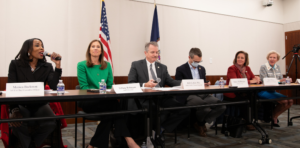
On December 2, 2024, Active Prince William’s co-chairs, Allen Muchnick and Mark Scheufler, separately delivered public statements at Northern Virginia’s joint annual transportation public meeting, before senior representatives of the six regional and state transportation agencies identified above  

Our statements are posted below.  As indicated in the announcement for this meeting, written comments related to any of the information presented at this meeting may be emailed or mailed through December 31, 2024.


Northern Virginia Joint Transportation Public Meeting

December 2, 2024

Statement of Allen Muchnick, Member

Virginia Bicycling Federation

and Active Prince William Boards of Directors

Good evening.  I’m Allen Muchnick, a City of Manassas resident and a long-time board member of the advocacy groups Active Prince William and the Virginia Bicycling Federation.

For more than seven decades, our region has repeatedly expanded major roadways in a futile quest to fix traffic congestion.  The result is a fiscally and environmentally unsustainable highway network, dysfunctional and ugly suburban sprawl, and inequitable and life-threatening mobility challenges, especially for households without multiple personal vehicles.

It’s time for Virginia’s transportation agencies to embrace the three guiding principles for transportation infrastructure investment articulated by the national advocacy group Transportation for America:

  • Design for safety over speed
  • Fix it first, and
  • Invest in the rest

Designing for safety over speed is essential to reduce Virginia’s unacceptable epidemic of traffic violence.  In 2023, Virginia traffic crashes killed 907 people, including 133 pedestrians, and injured nearly 64,000 people, including nearly 1700 pedestrians.  It’s past time to aggressively retrofit all of Northern Virginia’s multilane commercial arterial roadways to establish more survivable design speeds, as part of a comprehensive Vision Zero strategy.

Fixing our mobility infrastructure requires much better maintenance of Virginia’s pedestrian and bicycle facilities.   VDOT’s 2004 Policy for Integrating Bicycle and Pedestrian Accommodations states, in part:

  • VDOT will maintain bicycle and pedestrian accommodations as necessary to keep the accommodations usable and accessible ….. 
  • For sidewalks, shared use paths, and bicycle paths built within department right-of-way, built to department standards, and accepted for maintenance, VDOT will maintain these bicycle and pedestrian accommodations through replacement and repair.

However, VDOT still performs little maintenance and repair of its shared-use paths and sidewalks, except in response to reported complaints.  After construction, the pavement is left to deteriorate for decades and is fixed only after repeated complaints.  VDOT still has no annual budget or established policies and procedures to adequately and proactively assess and maintain its active mobility assets.

Thank you for this opportunity to comment.  We urge VDOT to better support active mobility in the years ahead.


Statement of Mark Scheufler, Active Prince William Co-Chair

Thank you for the opportunity to speak tonight.  I’m Mark Scheufler, Prince William County resident and 16-year VRE rider.

With the recent purchase of the Manassas Line and the planned completion of the Long Bridge in 2030, I strongly recommend VRE, region and state partner to support adding 2nd Platforms to the Manassas Park, Burke Centre, Rolling Road and Backlick Road stations to the near term Capital Improvement Plan.  This will allow for the Manassas Line to move to an all-day, all-week clock face schedule, with a few commuter train slots during peak-of-peak time frames.  The schedule along with 4-5 Amtrak trains per day will significantly increase ridership and lower capital costs due to the reduced train equipment needs that a high peak-of-peak commuter schedule requires.

More VRE service is vital for the region to take advantage of the VPRA multi-billion investment in the corridor and make better use of the VRE equipment that already carries high fixed costs regardless of the amount of service provided.  I-95 and I-66 are not getting any more capacity for the next 50 years.  VRE has the greatest ability to add significant mobility capacity in the region.

Boston/MBTA is an example of a rail system reworked their schedule to better serve people traveling in the middle of the day, in the evening and on weekends with the goal of transforming service from commuter rail to regional rail.  Their rail ridership is near pre-pandemic levels while VRE is still near 40%.

Existing plans do not go far enough to handle service disruptions with a higher frequency schedule especially with Amtrak trains and freight trains mixed in.  As a regular rider, service disruptions are a major hindrance when using the system.

I strongly recommend the 2nd platform project  be submitted for future Northern Virginia Transportation Authority regional funding.

But most importantly transportation agencies need to work with the localities/state to integrate projects such as the 2nd platform project/all day service with land use changes to increase mixed-use/residential density adjacent to stations to draw more ridership.  (This is especially needed in Fairfax County).  This only works if all-day all-week service is planned.  We have a major housing shortage in the region.  Planning housing/services adjacent to high capacity transit service is a solution.

With the completion of the I-66 and I-95 Express Lane projects, competitive bus schedules during peak periods will limit future VRE growth in some segments of the catchment area.  We need to start planning land use density improvements next to stations and 2nd platforms now to support high frequency service on the Manassas Line to begin when the Long Bridge opens.

Thank you for considering this testimony .


« Older posts Newer posts »