Ride of Silence – Manassas City
May 19 @ 7:00 pm – 8:30 pm
Free
Advancing active mobility in greater Prince William, Virginia

Free

During May 2021, the City of Manassas held three virtual public meetings on various transportation projects:
1) Tuesday, May 18 @ 7 pm–virtual public meeting on the Sudley Road Third Lane project . View the project design presentation on the Sudley Road Third Lane Project from the May 18 meeting.
2) Thursday, May 20 @ 7pm–virtual public meeting on four sidepath projects (Godwin Dr, Dumfries Rd, Gateway Blvd, and Wellington Rd trail gap) and three sidewalk projects (Portner Ave, Quarry St, and Gateway Blvd). View the meeting presentation and a 31-minute recording of the Zoom meeting.
3) Tuesday, May 25 @ 7pm–virtual public meeting on the Dean Drive Extension Project. View the project design presentation on the Dean Drive Extension Project.

The Prince William Board of County Supervisors and County transportation staff invite you to attend a virtual information session regarding the Route 28 Bypass project on Thursday, Feb. 18, 2021, at 7:00 p.m. This approximately $300 million infrastructure project, one of the largest in the history of Prince William County, will reduce traffic congestion, improve travel reliability and address other transportation challenges in the area.
The meeting will inform residents about the project’s background, its current status and aspects of the Route 28 Bypass that most directly impact Prince William County residents. While there are no major updates on the project at this time, the session will provide a baseline of information about the Route 28 Bypass while also sharing planned communication activities that will help citizens remain informed and involved as the project moves forward. The latest information about the project is available on Route28Bypass.com.
The Prince William County Department of Transportation (PWC DOT) will continue to host information sessions on the Route 28 Bypass project and address topics specific to Prince William County as the project progresses.
The public is invited to ask questions and provide feedback during the presentation. You may also submit questions or comments before using any of the mechanisms below.
Meeting Registration Information
https://theclearing.zoom.us/webinar/register/WN_P47suUPqQ0O0x1ZBK8KVlA
Please submit questions/comments about the Route 28 Bypass using one of the methods below. Submissions received before Feb. 18 at 5 pm may be addressed during the meeting. All questions will be responded to in a timely manner via email or route28Bypass.com.
Have thoughts on how to enhance communication efforts going forward? Please submit any feedback, comments, questions or concerns to PWCDOT:
March 15, 2021 Update: We have been informed by the City’s Director of Public Works that many of the bollards shown below have been removed. The City is now installing a single rigid bollard on the trail centerline, with additional bollards placed six feet apart at some locations. In addition, reflective tape will be installed near the top and the bottom of each bollard. While these changes significantly reduce the severity of the trail-bollard hazard, the users of these paths will still remain at some risk for serious and permanently debilitating and even fatal injuries from crashing into the remaining bollards. We urge all public agencies to heed the AASHTO guidance and FHWA recommendation (both cited below) to end the routine use of even single rigid bollards as its default design treatment to discourage motor vehicle incursions on shared-use paths.
July 2023 Update: The City of Manassas has finally replaced the former rigid black steel bollards at both entrances to its Winters Branch Trail with white plastic flexible posts with silver reflective tape! Thank you!!!
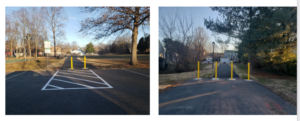
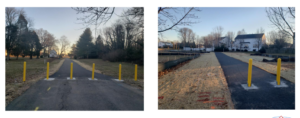
Active Prince William board member Allen Muchnick, a City of Manassas resident, sent the following notice to multiple City of Manassas officials on February 7, 2021:
I was pleased to see the lead article in the January 2021 issue of City Connection newsletter, featuring several newly built asphalt shared-use paths around Manassas. I commend City staff for working inter-departmentally to quickly fund, design, and build these valuable neighborhood connections.
However, my initial joy over these new connections was soon marred by disappointment and dread upon seeing the four photos of dangerous, unnecessary, and closely placed rigid trail bollards on Slides 20 and 21 of the Manassas Public Works annual report.
While intended to prevent both intentional and accidental intrusions by motor vehicles–and occasionally needed to prevent costly damage to fragile infrastructure, such as foot bridges–hard, rigid bollards installed within the traveled way of shared-use paths have been widely recognized for decades as a substantial hazard for people riding bicycles, causing many severe and permanent injuries and even deaths. An extensive bicyclist critique of trail bollards is posted here.
For that reason, nationally recognized guidance for the design and construction of shared-use paths have long cautioned against installing hard, rigid bollards on shared-use paths. A variety of simple and cost-effective alternative design treatments—starting with signs prohibiting entry by motor vehicles—are quite effective at preventing motor vehicle intrusions and vastly safer than trail bollards.
Although NOVA Parks’ 45-mile Washington and Old Dominion (W&OD) Trail includes scores of at-grade road crossings, NOVA Parks removed all of its former bollards and fences along that trail more than 20 years ago, in recognition of the significant danger that such obstructions pose to trail users. NOVA Parks has not seen any need to reinstall trail bollards since.
Where the risks and consequences of unwanted motor vehicle entry is significant and demonstrated, trail bollards should be installed only on the centerline of two-way shared-use paths, and flexible bollards should be used if feasible. If multiple bollards must be used, they should be used in sets of three (never two or four, to reduce head-on collisions) and spaced at least five feet apart to allow safe passage by bicycle trailers.
The Federal Highway Administration has long warned against installing bollards on recreational trails. The first bullet point states: “Even “properly” installed bollards constitute a serious and potentially fatal safety hazard to unwary trail users. In addition, no bollard layout that admits bicycles, tricycles, and bicycle trailers can exclude single-track motor vehicles such as motorcycles and mopeds. For these reasons, bollards should never be a default treatment, and should not be used unless there is a documented history of intrusion by unauthorized cars, trucks, or other unauthorized vehicles.”
Similarly, the AASHTO Guide for the Development of Bicycle Facilities (4th Edition, 2012) contains extensive guidance on trail bollards on pages 5-46 and 5-47, including these paragraphs:
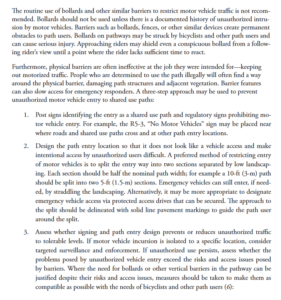
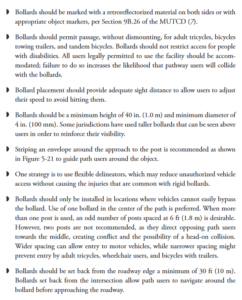
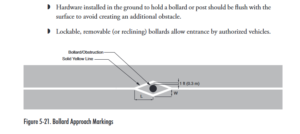
Since the above-referenced newly installed trail bollards are a well-recognized defective and unreasonably dangerous property condition for people riding bicycles, scooters, skate boards, and other devices, I ask that these trail bollards be removed immediately from the paths at Kinsley Mill Park, Tudor Lane, Oakenshaw Park, and Bartow Street and that none be installed along the still-unfinished path along the southern perimeter of the Metz Middle School property.
I’m confident the City of Manassas would never install a rigid bollard within a few feet of any vehicular travel lane, although such obstructions would mostly endanger vehicle exteriors, not human bodies. So, how can it be considered acceptable to expose non-encapsulated people traveling on balanced bicycles (or simply walking) to such dangerous obstructions?
###
© 2026 Active Prince William
Theme by Anders Noren — Up ↑
