Advancing active mobility in greater Prince William, Virginia

Category: Pedestrians (Page 2 of 7)

Our Statement At The VDOT NoVA District’s Spring 2023 Joint Transportation Meeting


Annual Joint Transportation Meeting for Northern Virginia, May 1, 2023
Statement of Allen Muchnick, Member of the Virginia Bicycling Federation
and Active Prince William Boards of Directors

Good evening.  I’m Allen Muchnick.  I live in the City of Manassas, and I serve on the boards of the Virginia Bicycling Federation and Active Prince William, statewide and sub-regional active transportation advocacy organizations, respectively.

We thank VDOT for recently re-filling its statewide bicycle and pedestrian planner position and for staffing a new statewide trails office.  We look forward to seeing those offices advance safe active mobility.  We believe it’s time to review and update both VDOT’s 2011 State Bicycle Policy Plan and the CTB’s 2004 Policy for Integrating Bicycle and Pedestrian Accommodations.

I commend VDOT’s NoVA District Office for initiating a study to estimate the cost to complete all locally planned but unfunded bicycle and pedestrian facilities within the NoVA District.  While most NoVA localities have robust active mobility plans and even Vision Zero programs, Prince William County still lacks both, so its official inventory of missing pedestrian and bicycle facilities is woefully incomplete.

Since 2010, VDOT’s roadway reconfiguration program has cost-effectively retrofit bike lanes and pedestrian crossing improvements on many dozens of roadways during scheduled resurfacing, especially in Fairfax County.  Prince William County, however, has largely ignored this enormous opportunity to improve the access and safety of its vulnerable road users.  We urge the County and VDOT to actively implement this program in our communities.

The alignment of US Bicycle Route 1 through Prince William County is a prime example where retrofitted bike lanes or paved shoulders are desperately needed.  Although AASHTO and VDOT established this route more than 40 years ago and a VDOT consultant re-evaluated the route’s alignment through NoVA nearly a decade ago, the bicycling conditions on several Prince William route segments are horrendous.  For example, the County’s online Bicycle Skill Level Map labels Old Bridge Road, part of Minnieville Rd, Aden Rd, and Fleetwood Dr—all lacking bicycle facilities and posted at 45-MPH–as “Roads to Avoid” and tags Hoadly Rd and Tanyard Hill Rd as “Low Comfort”.  VDOT’s 2015 Bicycle Level of Service Map for the NoVA District rated those segments similarly.  It’s long past time for VDOT and the County to fix these embarrassing and potentially deadly deficiencies.

To address the ongoing epidemic of pedestrian fatalities, VDOT should aggressively implement design-speed reductions and pedestrian safety improvements along its multi-lane commercial arterials.  VDOT and Prince William should also establish safer bike/ped crossings of I-95 and I-66 and extend the I-66 Trail, now being built in Fairfax County, over Bull Run to connect to both Balls Ford Rd and the Northern Virginia Community College’s Manassas campus.

In closing, we strongly support the recommended SMART SCALE, CMAQ, and RSTP awards for Manassas, Manassas Park, and Prince William County.

Thank you for this opportunity to comment.

###

“Taming Our Arterials” Webinar, September 29 @ 7 PM

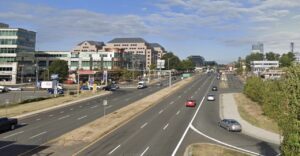
Multi-lane suburban arterial roads–such as Routes 1, 28, 123, and 234 Business in Prince William County– are dangerous and hostile for pedestrians and bicyclists.  How can we make these roads safer?  That’s the theme of this virtual panel discussion on Thursday, September 29, 2022 at 7 p.m., sponsored by our friends at the Fairfax Alliance for Better Bicycling, Toole Design Group, and the Coalition for Smarter Growth.

Register in advance on Zoom.

Andy Clarke of Toole Design Group, Fairfax County Lee District Supervisor Rodney Lusk, Stewart Schwartz of the Coalition for Smarter Growth, and Bill Cuttler of VDOT’s Northern Virginia Construction District will discuss long- and short-term methods that can be used to tame our big roads.  They will discuss some techniques that have been shown to work, and address how to overcome institutional barriers to making these changes.

Event Organizers

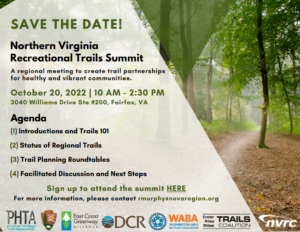
NoVA Trails Summit, October 20, 2022

The Northern Virginia Regional Commission (NVRC) will host a Northern Virginia Recreational Trails Summit on Thursday, October 20, 2022 from 10 am to 2:30 pm at its offices at 3040 Williams Drive, Suite 200, Fairfax VA 22031.

This will be a working meeting to identify opportunities to create connections and improve communities through recreational trails in Northern Virginia.

The Northern Virginia Regional Commission and partner organizations invite all interested jurisdictions and organizations to partner and share thoughts and ideas on how to improve our communities through the coordination and development of trails and parks.

Interested representatives and staff, community organizations, and businesses can register a member or representative.   NVRC and our partners look forward to a diverse and engaging group of attendees and would love to see new faces and hear new voices!  Space is limited, so please register early!

To learn more about NVRC and its role in the Potomac Heritage National Scenic Trail visit https://www.novaregion.org/299/Potomac-Heritage-National-Scenic-Trail.

Our Input for the Route 234-Clover Hill Road Bowtie Intersection

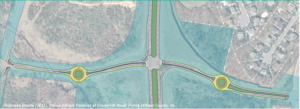
2017 Concept for a Clover Hill Road/Prince William Parkway “Bowtie” Intersection

Recently, the Prince William County Department of Transportation asked for our feedback on their proposed preliminary design for rebuilding the intersection of the Prince William Parkway (Route 234) and Clover Hill Road near Manassas as an “innovative” bowtie intersection, where all direct left turns are eliminated and instead accommodated via two roundabouts on the minor cross street.   Our reply is posted below.   We will track this upcoming project in the coming years as the design is refined for construction.


Thank you for soliciting Active Prince William’s input on how the redesigned intersection of Clover Hill Road at the Prince William Parkway can best serve people walking and bicycling.

Conventional On-Road Bike Lanes Are Appropriate for Clover Hill Road

Clover Hill Road provides an important low-traffic bicycling connection between the City of Manassas (and adjacent residential neighborhoods within the County) and Manassas Regional Airport and points west, including the Broad Run VRE station and the new Route 28 shared-use path that now extends though Bristow all the way to Nokesville.  On the southwest side of Route 234, Clover Hill Road provides critical bicycling access to a network of low-traffic, bicycling-friendly roads within and near Manassas Regional Airport, including Harry J Parrish Blvd. Wakeman Drive, Observation Drive, Piper Lane, Residency Road, Pennsylvania Avenue, Carolina Drive, and Gateway Blvd.

As such, Clover Hill Road is eminently useful for bicycle commuting to employment sites within and near the airport, to the Broad Run VRE station, and to points west in Bristow.  In addition, Clover Hill Road and the low-traffic roads within and around the airport are used extensively for recreational bicycling on evenings and weekends.
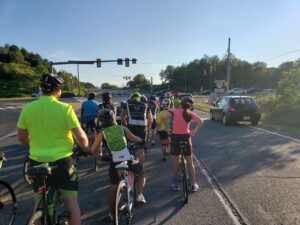
Bicyclists on Bull Run Bicycle’s Tuesday evening shop ride wait to cross Route 234 at Clover Hill Road. To avoid hazardous right-turning traffic on both sides of this intersection, the group waits for a green traffic signal in the left travel lane of Clover Hill Road.

Both City of Manassas roadways that connect to this segment of Clover Hill Road–i.e.. Clover Hill Road from Godwin Drive to Wellington Road and Godwin Drive from Clover Hill Road to Hastings Drive–already have conventional on-road bike lanes.  Thus, in addition to including sidewalks for pedestrians, the entire redesigned segment of Clover Hill Road should include conventional on-road bike lanes in both directions.

Note that VDOT’s website that describes bowtie intersections includes conventional on-road bike lanes on all four legs of that intersection (see the illustration copied below).
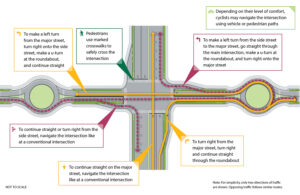
Since, as in the above illustration, the proposed design features dedicated right-turn-only lanes on Clover Hill Road at both approaches to the Prince William Parkway, it would be vital to install the bike lanes at both approaches to the Prince William Parkway between the straight-through travel lane on the left and the right-turn-only lane at the curb.

Within the roundabouts, the bike lanes–if any–should be on the far right and could be buffered or physically separated from roadway traffic.  Alternatively, especially if right-of-way is constrained at the roundabouts, the bike lanes could be discontinued within the roundabouts and bicyclists encouraged to navigate the roundabouts as either a driver centered within the travel lane or (using strategically placed curb ramps for access and egress) as a pedestrian using the sidewalk.

However, upon exiting each roundabout, right-turning motorists should be directed to yield to any bicycle traffic ahead and to carefully merge right across the continued bike lane to enter the emerging right-turn-only lane before reaching either the Parkway (along both southbound and northbound Clover Hill Road) or Godwin Drive (along northbound Clover Hill Road).

Please note that these same conflicts between right-turning motorists and straight-through bicyclists presently exist at the current Clover Hill Road/Route 234 Intersection in the absence of any bike lanes and that appropriate traffic engineering measures, involving pavement markings and signage, can optimize the safety of all road users.

Design This Intersection to Safely Accommodate the Future Shared-Use Path Along Route 234

Although this project won’t construct the long-planned missing shared-use path along Route 234, the design of this intersection should not preclude its future construction and should also ensure that pedestrians and bicyclists using that shared-use path can cross Clover Hill Road safely.  As a designated segment of the National Capital Trail Network, a continuous, high-quality shared-use path along Route 234 should be a priority for Prince William County.

Unobstructed right-of-way should be acquired and preserved as part of this project to accommodate the future Route 234 shared-use path, and the project design should ensure that the route and future design of this path would not be blocked or compromised by noise barriers, above-ground or buried utilities, or roadside signage, traffic signals, or street lighting.  Until the county decides whether this path will be constructed on the northeast or southwest side of Route 234, right-of-way should be reserved for the future shared-use path on both sides.

In addition, the intersection design should ensure that the future Route 234 Trail will have a safe, at-grade crossing of Clover Hill Road, presumably coordinated with the same traffic signal that regulates the Route 234 traffic.

Eliminate High-Speed Right-on-Red Turning Movements from Route 234 onto Clover Hill Road

Unlike VDOT’s model bowtie intersection illustrated above, the currently proposed intersection design incorporates two free-flowing, high-speed, right-turning movements, using pork-chop islands, for Route 234 traffic to enter Clover Hill Road.  We believe this currently proposed design feature would seriously endanger both 1) bicyclists and pedestrians crossing Route 234 at Clover Hill Road and 2) the users of the future Route 234 Trail crossing Clover Hill Road.

Vulnerable, non-motorized road and trail users who are crossing either roadway on a green traffic signal should not be endangered by high-speed traffic that is simultaneously turning right-on-red at near-freeway speeds at these pork-chop islands.  While a decision to completely ban all right-turn-on-red movements at this intersection might best be made by expert traffic engineers, we firmly believe that free-flowing right-on-red movements would be dangerous at this intersection and should not be promoted by design features such as pork-chop islands.

Instead, vehicle traffic entering Clover Hill Road from Route 234 should be encouraged to slow to the 25 MPH posted speed and carefully merge into the single travel lane approaching the roundabout, while bicyclists who have just crossed Route 234 on a green signal must merge into the bike lane at the right edge of the roadway.

Again, careful pavement marking and signing would help all road users safely negotiate these conflicts, whereas a design that promotes high-speed right-on-red vehicle traffic would endanger vulnerable road users.

Bicyclists and pedestrians crossing Route 234 at Clover Hill Road on a green traffic signal would primarily be endangered by motorists turning right-on-red from Route 234 at the far side of their crossing.  By contrast, users of the future Route 234 Trail crossing Clover Hill Road on a green traffic signal could encounter both motorists turning right-on-green from Route 234 as well as motorists turning right-on-red from Clover Hill Road.   All such right-turning movements would be safer if the design encourages motorists to slow or stop completely before entering a crosswalk and turning into the path of vulnerable road users.  Partial traffic signal phasing, such as leading pedestrian intervals, could also make these crossings safer.

Clover Hill Road is a local street posted for 25 MPH, and there is no compelling need to promote free-flowing right-turn-on-red vehicle movements onto Clover Hill Road.

The 2019 AADT for all connected local roadways (i.e., Clover Hill Road, Godwin Drive, and Harry J Parrish Blvd) ranges from 2100 to 4700, so Clover Hill Road only needs one travel lane per direction between intersections. The proposed design includes a grassy median along Clover Hill Road, but there’s no compelling need for a grassy median on a road posted for 25 MPH, and that grassy median is about a full-lane wide on the segment approaching Godwin Dr.

Active Prince William also supports the inclusion of a shared-use path along this entire segment of Clover Hill Road; however, such a path would not connect to any existing path along Clover Hill Road, Godwin Drive or Harry J. Parrish Blvd, and it appears that the long-planned path along the Route 234 Bypass won’t be built for the foreseeable future.  Thus, a shared-use path seems less essential, especially on the airport side of Route 234, provided that both sides of Clover Hill Road will have sidewalks and bike lanes.

If spatial or terrain constraints would otherwise preclude the addition of both on-road bike lanes and sidewalks along Clover Hill Road in both directions, consideration should be given to narrowing or eliminating the grassy medians.

Thank you for considering our input.

###
Our Comments on the Mathis Avenue Improvement Project

On March 31, 2022, Active Prince William submitted the following comments to the City of Manassas regarding its proposed Mathis Avenue Improvement Project:


Re: Mathis Avenue Improvement Project (T-086) Public Meeting Comments

On behalf of Active Prince William, I’m writing to submit the following comments in response to the March 17, public meeting for the above-referenced project.  Our all-volunteer organization seeks improved active mobility and public transportation throughout greater Prince William, to create more livable, equitable, and sustainable communities.

An Improved Public Process for Transportation Project Development

We sincerely appreciate the improved process used to involve the public at the 30% design stage for this capital transportation project, which included both a February 23 virtual public meeting and an in-person meeting held on March 17.  This public involvement process is far better than the one used by City staff for its recent Sudley Road Third Lane Project, which excluded all public input before preliminary engineering was at least 90% complete (including when that project had been re-scoped substantially twice, in December 2017 and in February 2021).  We hope this public comment opportunity reflects a permanent policy change to proactively involve the public in all City transportation projects going forward, ideally starting at the project scoping stage.

The Proposed Design is a Reasonable Interim Aesthetic Improvement but Lacks Essential Pedestrian Amenities for a Vibrant, Mixed-Use Street

As a final condition for a revitalized Mathis Avenue as a mixed-use, pedestrian-oriented street–ideally with robust bus transit service–the proposed design would be a major disappointment.  However, as an interim improvement intended to transform the appearance of this somewhat desolate commercial street and to promote future mixed-use redevelopment at minimal cost, this project does appear to have merit.

In particular, the proposed design provides sidewalks that are too narrow for comfortable two-way walking, are too close to the roadway, and lack street trees and pedestrian-serving street furniture in what should be much wider curbside planting strips and furniture zones.   In addition, the sidewalks are interrupted with frequent curb cuts, where motor vehicle cross flows impede safe and comfortable walking.

However, considering the need for Mathis Avenue to continue serving the existing auto-oriented businesses beside it, especially along the east side of this street, until redevelopment occurs some years in the future, the imperative to minimize right of way takings and to preserve the existing curb cuts is understandable.

To effectively promote the specific forms of redevelopment that the City seeks and to ensure that this redevelopment incorporates the necessary mobility infrastructure to equitably support that redevelopment, the City’s Department of Planning and Community Development should undertake a robust community-based planning process to develop a detailed form-based zoning code for the Mathis Avenue corridor.  Form-base zoning codes are a proven tool to effectively promote the specific forms of redevelopment desired by localities.

Bicycling Accommodations and Roadway Design Speed

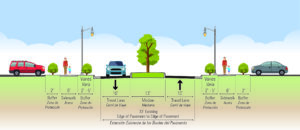
The lack of bike lanes (or any alternative bicycle facilities) in this project is disappointing but is also understandable since the existing curbs are not being moved to keep the existing storm sewer infrastructure in place, to minimize costs and commercial property impacts.  However, without bike lanes, the construction of raised medians will degrade bicycling conditions substantially, and those degraded conditions are unlikely to be remedied by a future roadway widening when the corridor is eventually redeveloped.

Presently, motorists can readily safely overtake people riding bicycles on Mathis Avenue by passing in the two-way central left-turn lane.  The raised medians, however, will prevent motorists from overtaking bicycle riders, who typically travel at 10-16 MPH.  Thus, people riding bicycles on Mathis Avenue will serve as slow-moving traffic-calming devices.  This roadway change will make bicycling unpleasant for nearly all riders and will subject people riding bicycles to increased harassment from frustrated motorists who are unable to pass.  Moreover, since Mathis Avenue would probably not be rebuilt with added bike lanes when redevelopment occurs in the future, this degradation of bicycling conditions on Mathis Avenue is likely permanent.

The fact that nearby Portner Avenue is designated as a bicycle route is no reason to degrade bicycling conditions on Mathis Avenue.  While many through bicyclists already prefer to travel on Portner Avenue, only Mathis Avenue serves the businesses and jobs located along Mathis Avenue, and people will someday live on this segment of Mathis Avenue too.

Thus, for both bicycle access and pedestrian safety, this project should strive to reduce the design speed for Mathis Avenue–and ideally the posted speed limit–to 20 MPH or below.   The raised median with street trees—and especially street trees in future curbside planting strips and future taller buildings closer to the roadway—should encourage motorists to drive more slowly on Mathis Avenue, but other design changes are needed too.

Shorter curb-return radii at corners and narrower sidewalk curb cuts would help reduce motor vehicle speeds, and electronic speed-feedback signs paired with posted speed limit signs (dynamic speed displays) would warn speeding motorists to slow down.  In addition, shared-lane markings (aka “sharrows”) centered in each travel lane would inform both motorists and bicycle riders that this is a shared roadway.

More Visible and Shorter Crosswalks

One notable design feature that should be changed is the proposed use of brick-colored stamped asphalt crosswalks.  While intended to impart historic charm, brown-colored crosswalks are far less conspicuous to motorists than modern high-visibility and reflective thermoplastic crosswalk markings.  The primary purpose of marked crosswalks is to alert motorists to the likely presence of crossing pedestrians, encouraging drivers to slow down, look for, prepare to yield to, and stop for pedestrians who may be crossing the roadway.  A faux-brick aesthetic is far less important than the safety of people who are walking across the street.

In addition, the final design of each intersection should pay particular attention to shortening the length of all crosswalks to the extent feasible and to install two separate curb ramps for the crosswalk landings at each corner.  The present design includes a single combined curb ramp at the southeast corner of Mathis Avenue and Sudley Road and at all four corners of Mathis Avenue and Liberia Avenue, the two on the north side not being rebuilt.

Designing shorter curb-return radii at all intersection corners, as suggested above to reduce the roadway design speed, would also reduce the crosswalk lengths at those intersections.

Consider Short Left-Turn Lanes at Reb Yank Drive and Carriage Lane

The advertised design does not include any space in the center of the roadway (beyond the intersection itself) to store vehicles waiting to turn left at Reb Yank Drive (from both directions) or southbound at Carriage Lane.  While shortening the raised medians to add short left-turn pockets at those three locations could increase travel speeds along Mathis Avenue and could also remove the proposed median refuges for crossing pedestrians at those unsignalized intersections, it may be prudent to add those left-turn pockets to smooth traffic flow, reduce traffic congestion, and lower the incidence of rear-end collisions at those locations.  However, if traffic studies have already documented that those left-turn pockets are unnecessary, then please retain them.

Thank you for considering our comments as you finalize the design of this project.

« Older posts Newer posts »